
On July 9, 2026, OpenAI made a move that changed the calculus for everyone currently paying — or avoiding paying — for AI access.
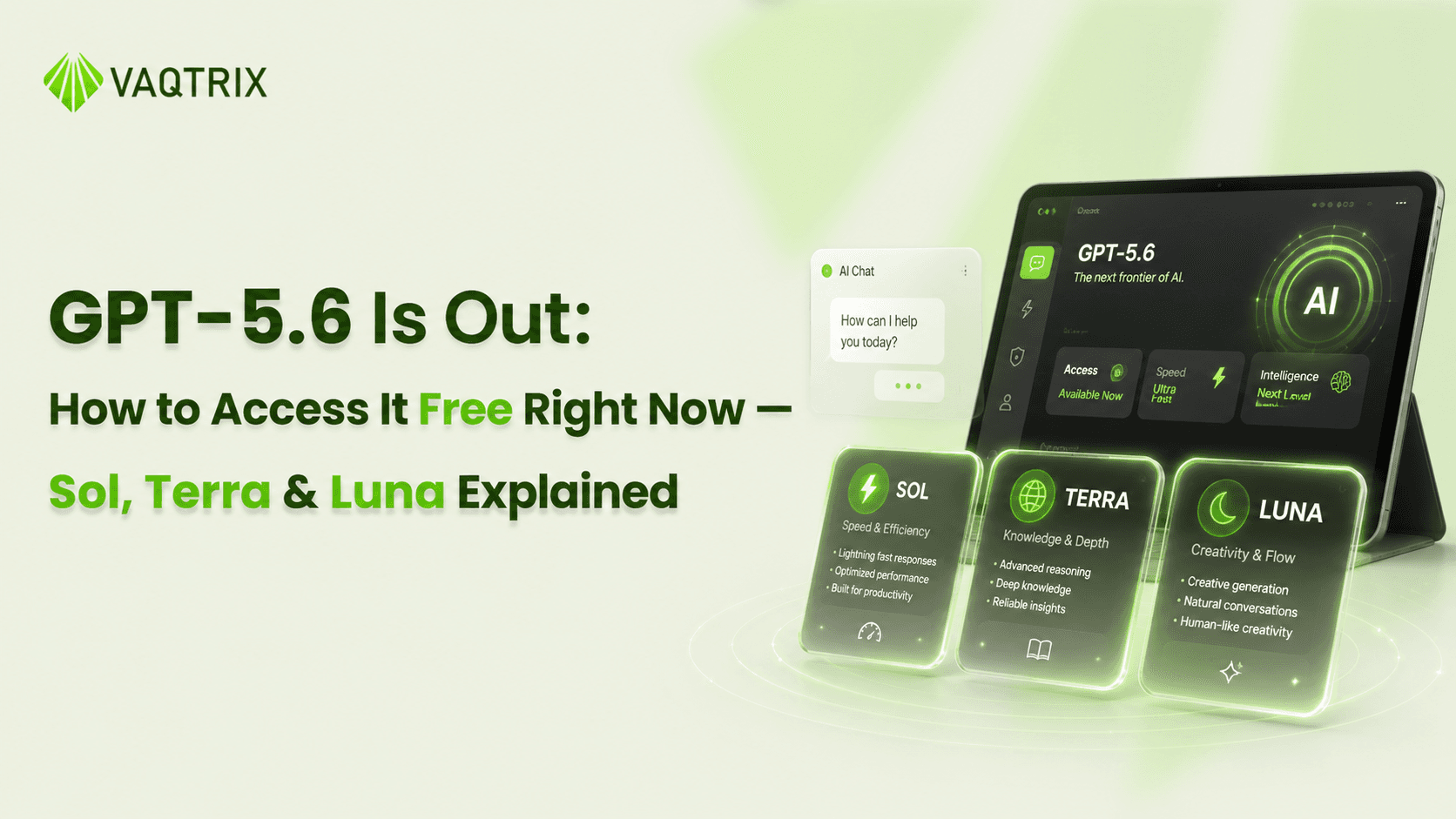
GPT-5.6 went live not as a single model but as a three-model family: Sol (the flagship), Terra (the balanced workhorse), and Luna (the speed-optimised lightweight). And buried inside the launch announcement was something that most coverage missed: free users already have access to one of them.
This is not a limited-time promotional trial like Higgsfield's 24-hour window. This is a permanent change to what ChatGPT gives you for nothing. If you have a free ChatGPT account — or no account at all — you can use GPT-5.6 Terra today without entering a card number, without a countdown timer, and without watermarks on your output.
The question is which path gets you what model, what the differences actually matter for, and whether Sol is worth pursuing through the legitimate free routes that do exist. Here is the complete picture.
What GPT-5.6 Actually Is
Before getting into access mechanics, it helps to understand what changed on July 9 and why it matters.
GPT-5.6 is not a minor update. According to OpenAI's official announcement, the Sol model achieves state-of-the-art results across coding, knowledge work, cybersecurity, and science while outperforming previous and competing frontier models with fewer tokens and at lower estimated cost. In plain terms: it is smarter than GPT-5.5, produces better results per dollar of API cost, and handles complex multi-step reasoning tasks that earlier models struggled with.
The three-model structure is new and worth understanding:
GPT-5.6 Sol — the flagship. Strongest reasoning, best performance on hard tasks, most expensive on API. This is the model that competes with Claude Sonnet 5 and Gemini Ultra for the top reasoning benchmark slots. API pricing sits at $30 per million output tokens after the introductory period ends.
GPT-5.6 Terra — the balanced mid-tier. OpenAI positions it as competitive with GPT-5.5 (the previous flagship) at roughly half the cost on the API side. Handles everyday writing, code explanations, summarisation, translation, and general research without strain. Free users get this.
GPT-5.6 Luna — the lightweight speed model. Optimised for simple, high-frequency tasks where response time matters more than depth. Cheapest API tier. Available in Work and Codex environments depending on plan.
The practical implication: if your day-to-day tasks are writing, research, summarisation, and straightforward coding, Terra does the job. The gap between Terra and Sol becomes meaningful in deep multi-step reasoning — complex debugging sessions, long agentic workflows, math-heavy problems, and the kind of extended analytical tasks where reasoning quality over many sequential steps determines the outcome.
Every Free Path to GPT-5.6 — Mapped Out
There are five legitimate routes to GPT-5.6 access at no cost, and they are not equally useful for every type of user.
Route 1: Free ChatGPT Account — Terra Already Included
This is the simplest and most overlooked fact about the GPT-5.6 launch.
Free and Go ChatGPT users get GPT-5.6 Terra at no cost. Usage limits apply, and OpenAI adjusts them over time based on platform load — but the access is real, permanent, and requires nothing beyond a free account.
If you have not touched ChatGPT in a while because the model quality on the free tier felt behind, this changes that calculation. Terra is not a consolation prize labelled GPT-5.6 to make free users feel included. OpenAI's own positioning is that Terra performs comparably to GPT-5.5, which was the paid flagship two weeks ago. The tool that Plus subscribers were paying $20/month for on July 8th is now free for everyone on July 9th.
How to access it: Go to chat.openai.com, sign up or log in with a free account, and start chatting. Terra is the default model for free users.
What you can use it for: Writing, editing, research, summarisation, translation, brainstorming, basic coding, image understanding, general Q&A.
What you cannot use it for: Extended multi-step agentic tasks, deep reasoning chains, the highest-quality code generation Sol handles.
Route 2: ChatGPT Work & Codex — Terra + Luna Free Access
If you are a developer or working in a technical environment, the ChatGPT Work workspace and Codex coding interface give free-tier users access to Terra by default in those specific environments, subject to usage caps.
Codex specifically is OpenAI's agentic coding environment — it can run code, interact with files, and execute multi-step programming tasks rather than just generating code snippets to copy. Luna is also available through Codex for high-frequency lighter tasks. This is the free route most relevant for developers who want to evaluate GPT-5.6's coding performance before committing to a paid plan.
How to access it: Sign up for a free OpenAI account, navigate to the Work environment or Codex at openai.com/codex, and use Terra and Luna within the free usage limits.
Route 3: GitHub Copilot Free Tier — Sol Access Limited
This one requires some context. GitHub Copilot added GPT-5.6 models within hours of the July 9 launch. The free tier of GitHub Copilot provides 2,000 code completions and 50 chat messages per month.
The Copilot free tier does not give unlimited Sol access — but it does give you Sol for code completion and chat tasks within those limits. For a developer evaluating whether Sol's reasoning improvements over Terra are meaningful for their specific coding workflow, 50 chat messages and 2,000 completions per month is enough to run a genuine comparison test without paying.
How to access it: Go to github.com/features/copilot, sign in with your GitHub account (free to create), and activate the free tier.
What you get: 2,000 code completions/month + 50 chat messages/month with GPT-5.6 Sol powering the interactions within your IDE.
Route 4: Third-Party Platforms with Free Trials — Sol Access
For users specifically wanting Sol rather than Terra, and who want more than the Copilot free tier provides, third-party platforms that integrate the GPT-5.6 family and offer their own free trials are a legitimate route.
Platforms like Felo AI, EaseMate AI, and similar services that integrate OpenAI models often run 7-day trials that unlock the full model family including Sol. These are not grey-market tools — they are licensed API partners offering trial periods to attract subscribers. The access is real, the output quality matches direct OpenAI access, and the risk is zero beyond the standard consideration of entering card details for trials that auto-renew.
The same principle applies here as with any trial: set a calendar reminder, cancel before the trial period ends if you do not want to continue.
How to access it: Search for the current best-reviewed platforms integrating GPT-5.6 Sol and offering free trials — the landscape changes frequently as new services launch and existing ones adjust their offers. As of July 2026, Felo AI and EaseMate AI both provide GPT-5.6 access on their trial tiers.
Route 5: Puter.js Free API Access — For Developers Only
This one is genuinely interesting and most people have not heard of it.
Puter.js provides free, unlimited access to the OpenAI API including GPT-5.6 Sol, Terra, and Luna without needing an OpenAI API key. It is a JavaScript library designed for building web applications, and it routes API calls through Puter's own infrastructure.
The catch is obvious: this is a developer tool, not a consumer product. You need to be comfortable writing JavaScript to use it, and the "unlimited" access is subject to Puter's own usage policies and rate limits. But for a developer who wants to build and test applications using GPT-5.6 without the cost of direct OpenAI API credits during the development phase, this is a legitimate and functional option that currently costs nothing.
How to access it: Go to developer.puter.com and read the tutorial linked above. Requires JavaScript knowledge and building inside the Puter.js framework.
Sol vs Terra vs Luna: When Each One Actually Matters
The model choice question is where most people get confused — either assuming Terra is meaningfully worse than Sol for everything, or assuming there is no difference. Neither is accurate.
Use Terra for: — Writing assistance across any format or length — Research synthesis and summarisation — Translation between languages — Straightforward coding tasks — writing functions, explaining code, debugging simple errors — Answering questions that require knowledge but not extended reasoning chains — Image analysis and description
Use Sol for: — Complex multi-step debugging where reasoning over many sequential steps determines the outcome — Long agentic workflows where the model needs to plan and execute over many steps without losing context quality — Mathematical problem solving requiring sustained logical reasoning — Cybersecurity analysis and vulnerability assessment — Science and research tasks where the difference between a good answer and a correct answer is significant
Use Luna for: — High-frequency, simple tasks where response speed matters more than depth — Batch processing of straightforward content — Real-time applications where latency is a constraint
For the majority of knowledge workers, content creators, and business users, Terra handles 90% of daily tasks without hitting its limits. The 10% where Sol genuinely changes outcomes is concentrated in technical, scientific, and deeply analytical workflows.
How GPT-5.6 Compares to What Else Is Out Right Now
The July 2026 AI model landscape has shifted significantly, and GPT-5.6's arrival is not in a vacuum.
GPT-5.6 Sol vs Claude Sonnet 5
Anthropic launched Claude Sonnet 5 on June 30, 2026, with intro pricing at $2 per million input tokens and $10 per million output tokens until August 31, 2026. Claude Sonnet 5 was specifically built for stronger reasoning, coding, and multi-step agent workflows. The head-to-head between Sol and Sonnet 5 is genuinely close on most benchmarks, with Sol pulling ahead on science and mathematics and Sonnet 5 holding advantages in specific coding and agentic task categories. Both are meaningfully stronger than their predecessors. If you are currently on Claude Free and not getting what you need, GPT-5.6 Terra on ChatGPT Free is worth testing as a direct comparison.
GPT-5.6 vs Gemini Omni Flash / Nano Banana 2 Lite
Google launched Nano Banana 2 Lite and Gemini Omni Flash on June 30, 2026. Gemini Omni Flash is primarily a video generation and conversational video editing tool rather than a text reasoning model — it serves a different use case than the GPT-5.6 family. Nano Banana 2 Lite is Google's fast image generation model useful for product visuals, ad creatives, and app-based image workflows. These are not direct competitors to GPT-5.6's text and reasoning capabilities but are relevant if you are thinking about a combined text + image/video workflow.
GPT-5.6 vs NVIDIA Nemotron-Labs-TwoTower
NVIDIA's recently launched Nemotron-Labs-TwoTower is an open-weight diffusion language model generating text in parallel for 2.42x higher throughput while maintaining 98.7% of baseline quality. This is primarily a technical/developer consideration — for organisations running high-volume inference at scale, Nemotron's throughput advantage matters. For individual users and most business applications, GPT-5.6 Terra through ChatGPT remains the simpler and more accessible choice.
Tutorial Resources Worth Bookmarking
For getting up to speed with GPT-5.6's specific capabilities and how to prompt Sol for its best reasoning output, a few resources stand out from the July 2026 coverage:
OpenAI's official GPT-5.6 guide — Available at openai.com/index/gpt-5-6. The technical details on Sol's reasoning improvements and the plan access breakdown are worth reading before choosing which tier to target.
Coursiv's access guide — coursiv.io/blog/chatgpt-5-6 has a clear breakdown of which model is available on which plan and through which product surface — because the Sol/Terra/Luna split across ChatGPT, Work, Codex, and the API is not identical, and the official documentation can be confusing.
APIdog's free access breakdown — apidog.com/blog/gpt-5-6-free is the most thorough current resource on every legitimate free-access pathway, written for developers but readable by non-technical users.
On YouTube, search "GPT-5.6 vs Claude Sonnet 5 comparison July 2026" for current head-to-head benchmark tests. Multiple creators have run both models through identical prompts in the two weeks since launch, and the comparison videos are genuinely useful for understanding where each model's strengths show up in practice.
Common Mistakes When Switching to GPT-5.6
A few patterns keep showing up in community discussions since the July 9 launch that are worth knowing before you start:
Assuming Sol is automatically better for your use case. For most everyday writing and research tasks, Terra performs comparably and the difference is not perceptible. The upgrade to Sol is worth pursuing only if you have hit specific limits on Terra's reasoning that affected the quality of an actual output you needed.
Not adjusting prompting style for the new model. GPT-5.6 Sol's extended reasoning capability means it benefits from prompts that explicitly ask it to think through problems step by step, consider alternatives, and show its reasoning. Prompts written for faster models that expected immediate answers sometimes produce better results from Sol when rewritten to invite extended reasoning.
Overlooking the free Terra access. The most common missed opportunity since launch is users still on GPT-3.5 or GPT-4 on the free tier — not realising that Terra is already available without any plan change. If you have a free ChatGPT account and have not opened it since July 9, you already have a meaningfully better model waiting.
Paying for Plus without testing Terra first. If your use case is primarily content and research rather than deep technical reasoning, Terra may be sufficient and Plus ($20/month) may not be necessary. Test Terra for two weeks on your actual daily tasks before deciding whether Sol's additional capability justifies the cost.
The Honest Summary
GPT-5.6 is a genuine step forward — not a marketing refresh. Sol is meaningfully stronger than GPT-5.5 on the reasoning tasks that matter most for technical and analytical work. Terra gives free users a model that was the paid flagship last month. And the access paths are clearer than most AI launches: free account for Terra, Copilot free tier for limited Sol, third-party trials for full Sol evaluation, and the API for developers building on top of it.
If you have been waiting to try GPT-5.6, the wait is over. Terra is already there in your free account. Whether Sol is worth pursuing depends on what you are actually trying to do — and two weeks of Terra on your real tasks will tell you more than any benchmark comparison.
How Businesses Are Actually Using GPT-5.6 Right Now
The practical business applications that have emerged in the two weeks since launch are worth covering directly — because the gap between "what this model can do" and "what businesses are actually doing with it" is always instructive.
Content and Marketing Operations
Marketing teams are the heaviest early adopters of Terra in the ChatGPT free tier upgrade. The most common workflow: long-form content briefs fed into Terra for first-draft generation, human editing for voice and accuracy, then Terra used again for headline and meta description variations, social caption adaptation, and email subject line testing. The cycle that previously required either significant budget (paid AI access) or significant time (human writing from scratch) now runs on the free tier for most steps.
For businesses running website development projects specifically, GPT-5.6 Terra is proving useful for generating SEO-structured content briefs, writing first drafts of page copy, and producing structured FAQ sections that align with AEO best practices — all without a paid subscription.
Customer Service and Support Documentation
Mid-sized businesses are using Terra to generate and maintain support documentation at a scale that was previously only feasible with dedicated content teams. A single product update that previously required a technical writer to revise five help articles, three FAQ sections, and a changelog entry can now be handled in a single Terra session — with human review catching the edge cases and brand voice adjustments that the model still occasionally misses.
Software Development — Terra vs Sol in Practice
The developer community's early assessment of Terra vs Sol is settling into a clear pattern: Terra is sufficient for the majority of coding tasks that do not involve extended reasoning over complex multi-file codebases. Writing individual functions, explaining unfamiliar code, generating boilerplate, and handling debugging questions with clear error messages — Terra handles all of this without hitting its limits.
Sol pulls ahead specifically in the scenarios where a developer needs the model to hold a complex mental model across many files and many sequential reasoning steps simultaneously. Full codebase refactoring, architectural decision-making for large systems, and the kind of extended debugging session where the root cause is buried inside an interaction between multiple components — these are where Sol's additional reasoning capacity produces meaningfully better outcomes than Terra.
For most individual developers and small teams, Terra is the right free starting point. The upgrade to Sol via GitHub Copilot's free tier (for limited access) or a paid plan (for sustained access) is worth evaluating after identifying the specific bottlenecks where Terra's reasoning falls short in practice.
Research and Analysis
Knowledge workers in consulting, finance, legal, and research roles are using Terra for the synthesis and summarisation tasks that previously consumed disproportionate time. Feeding a long research report or a set of documents to Terra and asking for structured analysis, key points, and potential questions it raises is producing genuinely useful first-pass output that significantly accelerates the human-led analytical process.
The important limitation to understand: Terra (and Sol) can still produce confident-sounding outputs that contain factual errors, particularly on specific numerical claims, recent events not in the training data, and highly specialised domain knowledge. Any research output generated by GPT-5.6 should be verified against primary sources before being used in client-facing or high-stakes contexts.
What to Do If the Free Tier Limits Are Not Enough
The free ChatGPT tier's usage limits are real, and they adjust over time based on platform load. If you are hitting them regularly, there are three options worth considering before defaulting to the $20/month Plus plan.
Option 1 — GitHub Copilot Free Tier for Developer Use Cases If your primary GPT-5.6 use is coding, the Copilot free tier gives you Sol-quality access within your IDE for 2,000 completions and 50 chat messages per month. For many individual developers, this is sufficient.
Option 2 — ChatGPT Plus at $20/Month The straightforward paid route. Plus gives you Sol access with higher reasoning settings, priority access during peak times, and larger usage caps on Terra and Luna. The annual billing option (when available) reduces the effective monthly cost.
Option 3 — API Access for Developers and Builders If you are building applications rather than using ChatGPT directly, the API gives you precise cost control per token. Terra is available at significantly lower cost per million tokens than Sol, and for applications where request volume is predictable, the API is often more cost-effective than a flat monthly subscription.
The decision between these options should be driven by which specific limit you are hitting and why — not by a general desire for "more AI access." Two weeks of Terra on your actual daily tasks will identify clearly whether the constraints you are experiencing are usage-volume limits (more tasks than the free tier allows), reasoning-quality limits (Terra cannot handle the specific complexity of your tasks), or model-access limits (you specifically need Sol's capabilities rather than Terra's).
The Bottom Line
GPT-5.6 is the most significant model update OpenAI has shipped in the post-GPT-5 era, and the decision to put Terra — a model that competes with last month's paid flagship — on the free tier is a meaningful statement about where the competitive pressure in the AI market is pushing pricing.
Free users have a better model than they had last week. That is simply true and worth acting on if you have not opened ChatGPT recently.
Sol is the one to pursue if your specific workflows hit the reasoning ceiling of Terra — and the free routes to Sol through GitHub Copilot and third-party platform trials are legitimate enough that most users can evaluate it properly before committing to a paid subscription.
Set the ChatGPT bookmark. Update the GitHub Copilot extension. Try Terra on your actual daily tasks for a week. The case for or against Sol will make itself.
Vaqtrix builds AI development solutions and AI-powered digital marketing systems for businesses across the UK, USA, and worldwide — integrating the latest models including GPT-5.6, Claude Sonnet 5, and Gemini into real business workflows that produce measurable results. If you want to understand how the current AI model landscape fits your specific business context, get in touch and we will help you figure out exactly what to use and how.
Frequently Asked Questions
How can users access GPT-5.6 for free?
The article explains several legitimate free-access routes, including free ChatGPT access for Terra, Codex or Work environments for supported users, GitHub Copilot free-tier access for developers, third-party trials, and developer-oriented API routes.
What is the difference between GPT-5.6 Sol, Terra, and Luna?
Sol is described as the flagship reasoning model, Terra as the balanced general-purpose model for everyday work, and Luna as the lightweight speed-focused model for simpler high-frequency tasks.
Should most users start with Terra or Sol?
Most users should start with Terra for writing, research, summarisation, and straightforward coding. Sol is more useful when a task requires deep multi-step reasoning, complex debugging, mathematical analysis, or sustained technical work.
When should a business consider paid GPT-5.6 access?
A business should consider paid access when free-tier usage limits block regular work, when Sol-level reasoning materially improves outcomes, or when API access is needed for a product, workflow, or internal automation system.